The pace of microbial discovery has accelerated dramatically in recent years due to advances in metagenomics, environmental DNA sequencing, AI-assisted analysis, and deep-ocean exploration. Scientists are now identifying entirely new microbial groups that were invisible to traditional laboratory methods.
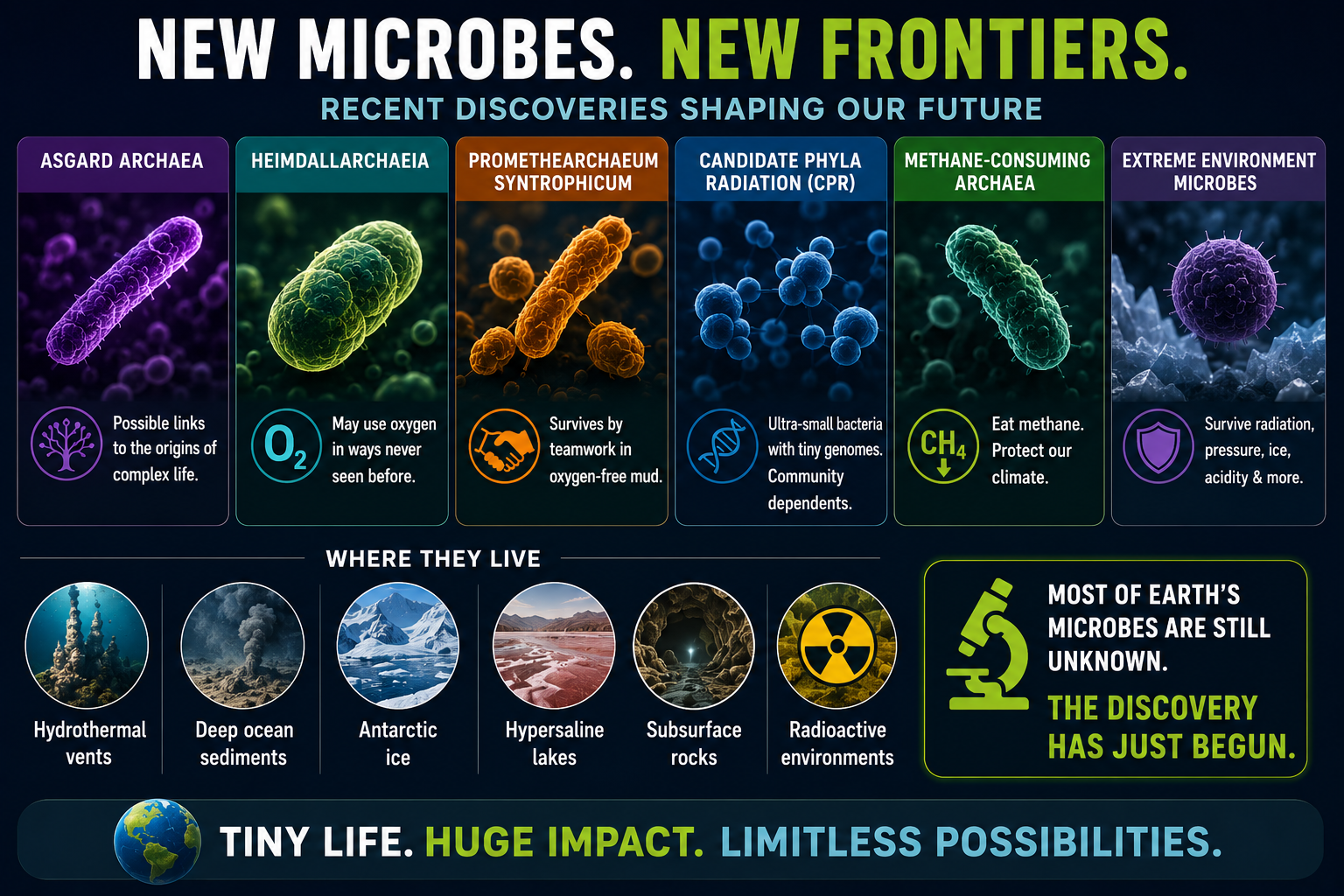
One of the most important recent discoveries involves the rapidly expanding group known as Asgard archaea. These microbes are considered some of the closest known relatives of complex eukaryotic cells.
Lokiarchaeota, first identified near Arctic hydrothermal vents, contain genes linked to cytoskeletal structures and membrane remodeling, features once thought unique to complex organisms. Their discovery reshaped scientific theories about how eukaryotic cells may have evolved.
Heimdallarchaeia attracted major attention because some species appear capable of oxygen-utilizing metabolism, suggesting that certain ancestral microbes may have adapted to oxygen earlier than previously believed.
Promethearchaeum syntrophicum, isolated from deep marine sediments near Japan, grows extremely slowly in oxygen-free conditions and survives through close metabolic cooperation with neighboring microbes. Scientists consider it one of the best living models for studying the evolutionary transition between simple microbial cells and complex life.
Researchers have also identified ultra-small microbes belonging to the Candidate Phyla Radiation (CPR) group. These bacteria possess extremely reduced genomes and appear highly dependent on surrounding microbial communities for nutrients and survival.
In deep marine sediments, scientists continue discovering methane-consuming archaea that prevent large amounts of methane from escaping into the atmosphere. These microbes are increasingly important in climate and carbon-cycle research.
Other recently identified microbes from Antarctic ice, hydrothermal vents, subseafloor rocks, hypersaline lakes, and radioactive environments have demonstrated extraordinary resistance to:
-
extreme pressure
-
radiation
-
cold
-
acidity
-
nutrient scarcity
Together, these discoveries are expanding scientific understanding of evolution, cellular complexity, and the limits of life itself. Scientists now believe that the overwhelming majority of microbial diversity on Earth still remains undiscovered.
Advances in DNA sequencing and deep-environment exploration are uncovering microbial diversity once completely invisible to science.