Microbial DNA is extraordinarily diverse. Some microbial species share large portions of their genetic sequences, while others are so genetically different that they represent entirely separate branches of life that diverged billions of years ago.
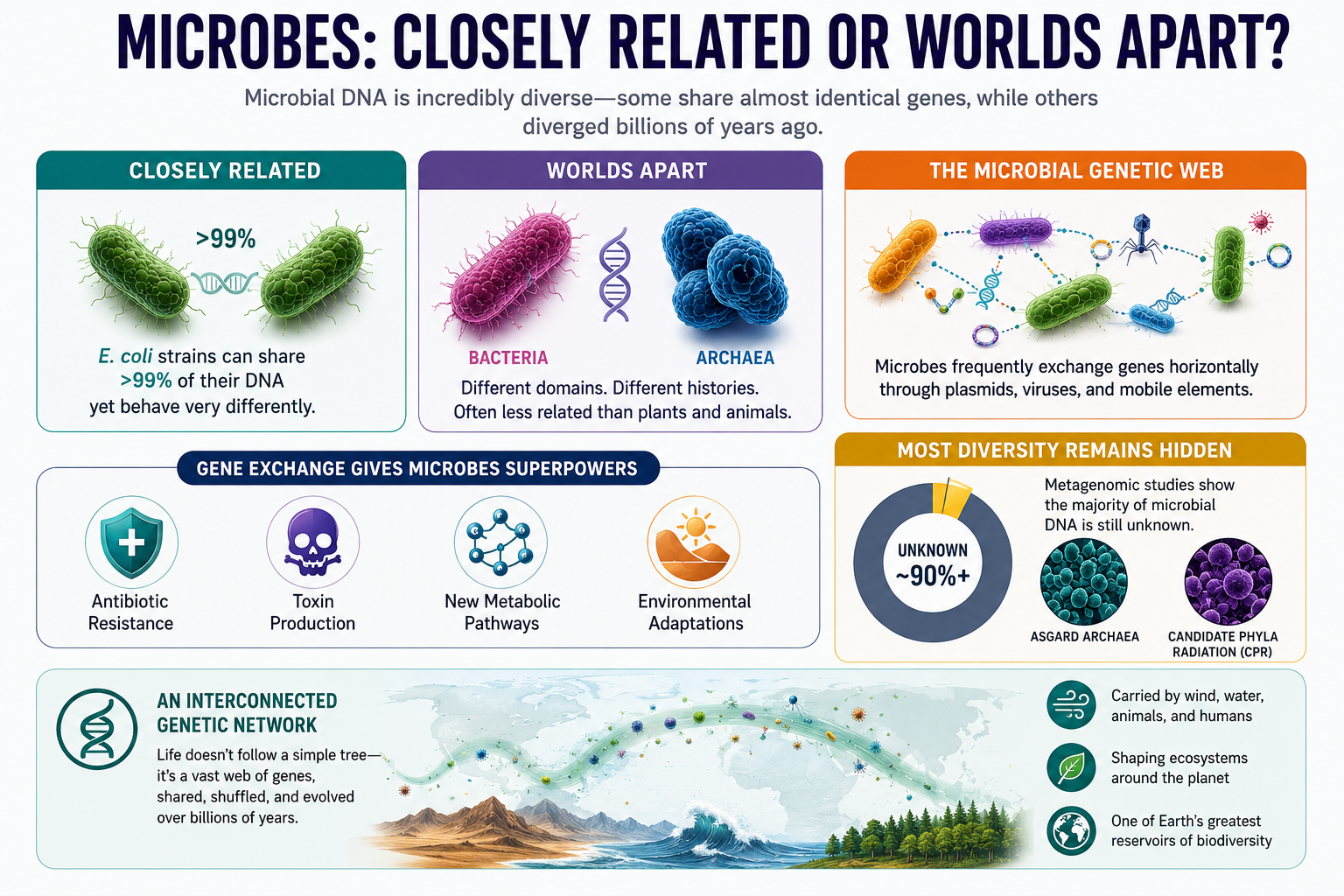
Closely related microbes often differ by only small changes in specific genes. For example, certain strains of Escherichia coli may share over 99% of their DNA while behaving very differently, with some remaining harmless and others causing severe disease.
At larger evolutionary scales, the differences become much more dramatic. Bacteria and archaea, although both microscopic and structurally simple, are genetically so distinct that they belong to separate domains of life. In many cases, microbes living side by side in the same environment may be less genetically related than plants are to animals.
Microbial evolution is also unusual because microbes frequently exchange genes horizontally rather than inheriting DNA only from parent organisms. Through processes such as plasmid transfer and viral exchange, microbes can rapidly acquire new capabilities including antibiotic resistance, toxin production, new metabolic pathways and environmental adaptations
This creates a complex genetic network where unrelated species may still share important functional genes.
Modern metagenomic studies have revealed that most microbial genetic diversity on Earth remains unknown. Entire microbial groups discovered in recent years, including many Asgard archaea and Candidate Phyla Radiation bacteria, contain genes unlike anything previously identified.
Despite their microscopic size, microbes collectively contain one of the largest reservoirs of genetic diversity ever known. Scientists now view the microbial world less as a simple evolutionary tree and more as an enormous interconnected genetic web shaped by billions of years of adaptation and gene exchange.
Microbial species may appear similar microscopically while being extraordinarily different genetically.