
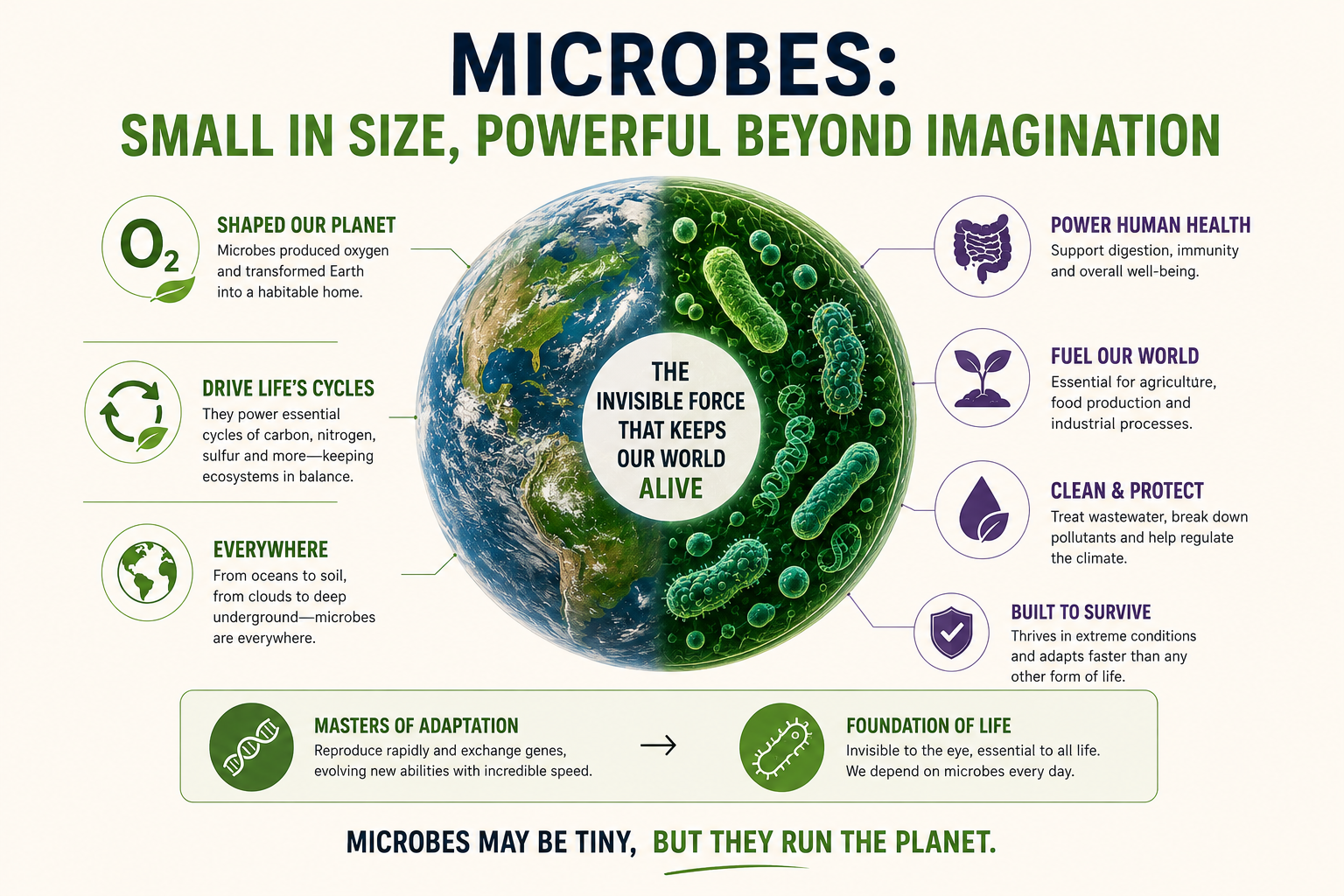
Microbes are microscopic, yet they have shaped Earth more profoundly than any plant or animal species. Long before complex life evolved, microbes transformed the planet’s atmosphere, oceans, and chemical systems, making Earth habitable for all later organisms.
Photosynthetic microbes such as cyanobacteria produced much of the oxygen that now exists in the atmosphere. Other microbial groups continue to drive the global cycling of carbon, nitrogen, sulfur, methane, and phosphorus, processes essential for maintaining ecosystems and climate stability.
Their influence extends far beyond the environment. Microbes affect:
Some microbes can survive conditions that would destroy most known life forms, including extreme heat, radiation, pressure, acidity, and dehydration. Others can generate electricity, degrade toxic pollutants, produce antibiotics, or capture carbon dioxide.
Microbes are also extraordinarily adaptable. Because they reproduce rapidly and exchange genes efficiently, they can evolve new metabolic capabilities far faster than larger organisms. Antibiotic resistance, plastic degradation, methane metabolism, and industrial biochemistry all demonstrate this evolutionary flexibility.
In terms of sheer scale, microbes dominate the biosphere. They exist in oceans, soils, rocks, clouds, glaciers, deep underground ecosystems, and within nearly every multicellular organism on Earth.
Despite being invisible to the naked eye, microbes collectively regulate many of the biological and chemical systems that keep the planet functioning. Human civilization ultimately depends on processes that microbial life has been performing for billions of years.
Microbes are among Earth’s most powerful organisms because many of the systems that keep the planet habitable ultimately depend on them.