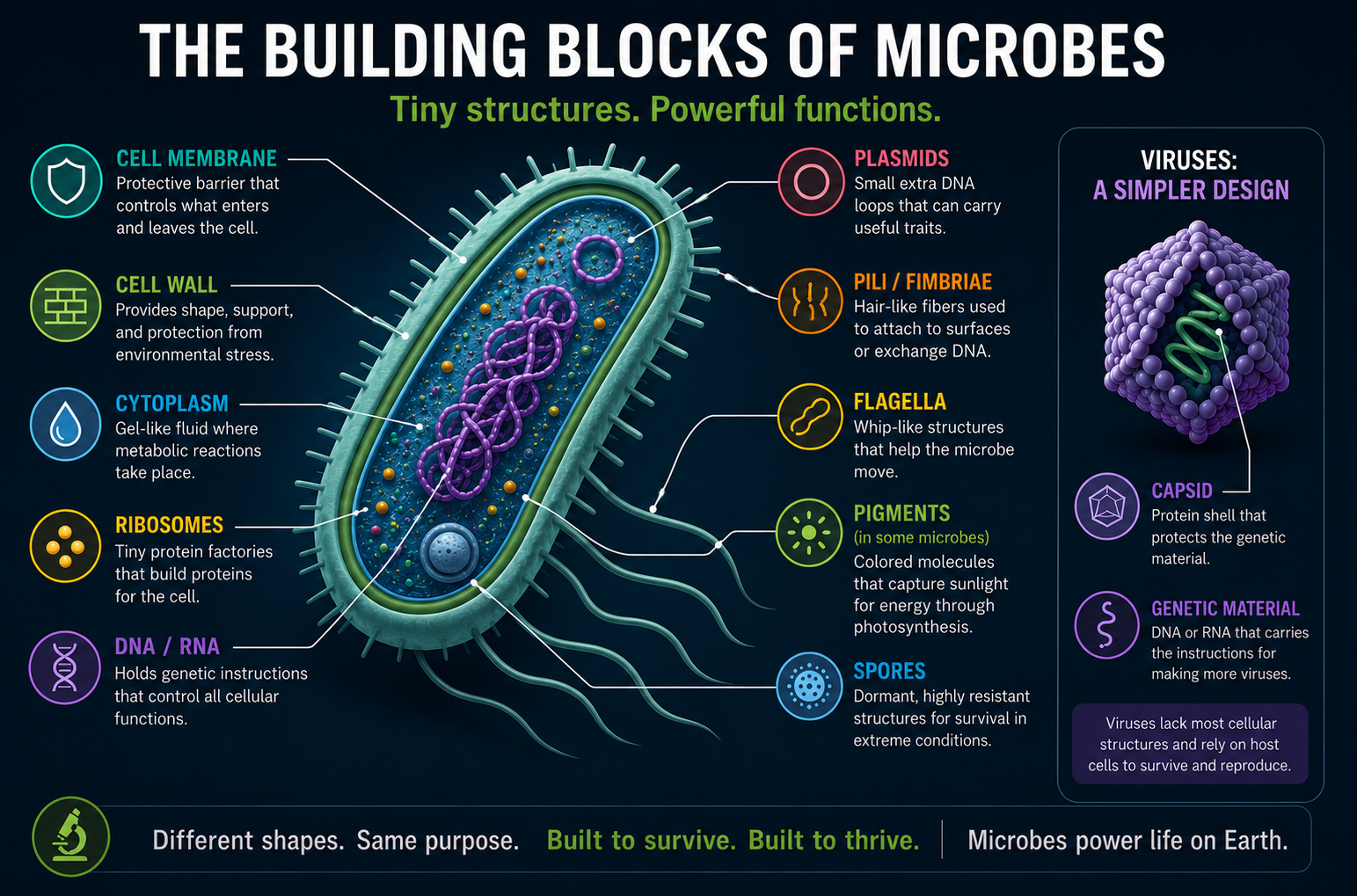
Although microbes are incredibly diverse, many share common structural components that help them survive, grow, reproduce, and interact with their environment.
The cell membrane acts as a protective boundary that controls the movement of nutrients, gases, and waste into and out of the cell. Outside this membrane, many microbes possess a cell wall, which provides structural support and protection against environmental stress.
Inside the cell lies the cytoplasm, a gel-like region where most metabolic reactions occur. Suspended within it are ribosomes, which produce proteins required for cellular activity and survival.
The microbe’s genetic instructions are stored in its DNA or RNA. In bacteria and archaea, this genetic material usually exists freely within the cell rather than inside a nucleus. Some microbes also contain small extra DNA molecules called plasmids, which often carry useful traits such as antibiotic resistance.
Certain microbes possess flagella, whip-like structures used for movement, while others use pili or fimbriae to attach to surfaces or exchange genetic material with neighboring cells.
Photosynthetic microbes contain pigments and specialized structures that capture sunlight for energy production. Some microbes additionally form spores, highly resistant dormant structures that help them survive extreme heat, dryness, radiation, or nutrient scarcity.
Viruses differ from cellular microbes because they lack most internal cellular structures. Instead, they consist mainly of genetic material enclosed within a protective protein shell called a capsid.
Together, these structures allow microbes to perform an enormous range of functions, from photosynthesis and decomposition to infection, nutrient cycling, and survival in some of Earth’s harshest environments.
The remarkable diversity of microbial structures allows microscopic life to survive in environments ranging from the human body to some of Earth’s harshest ecosystems.