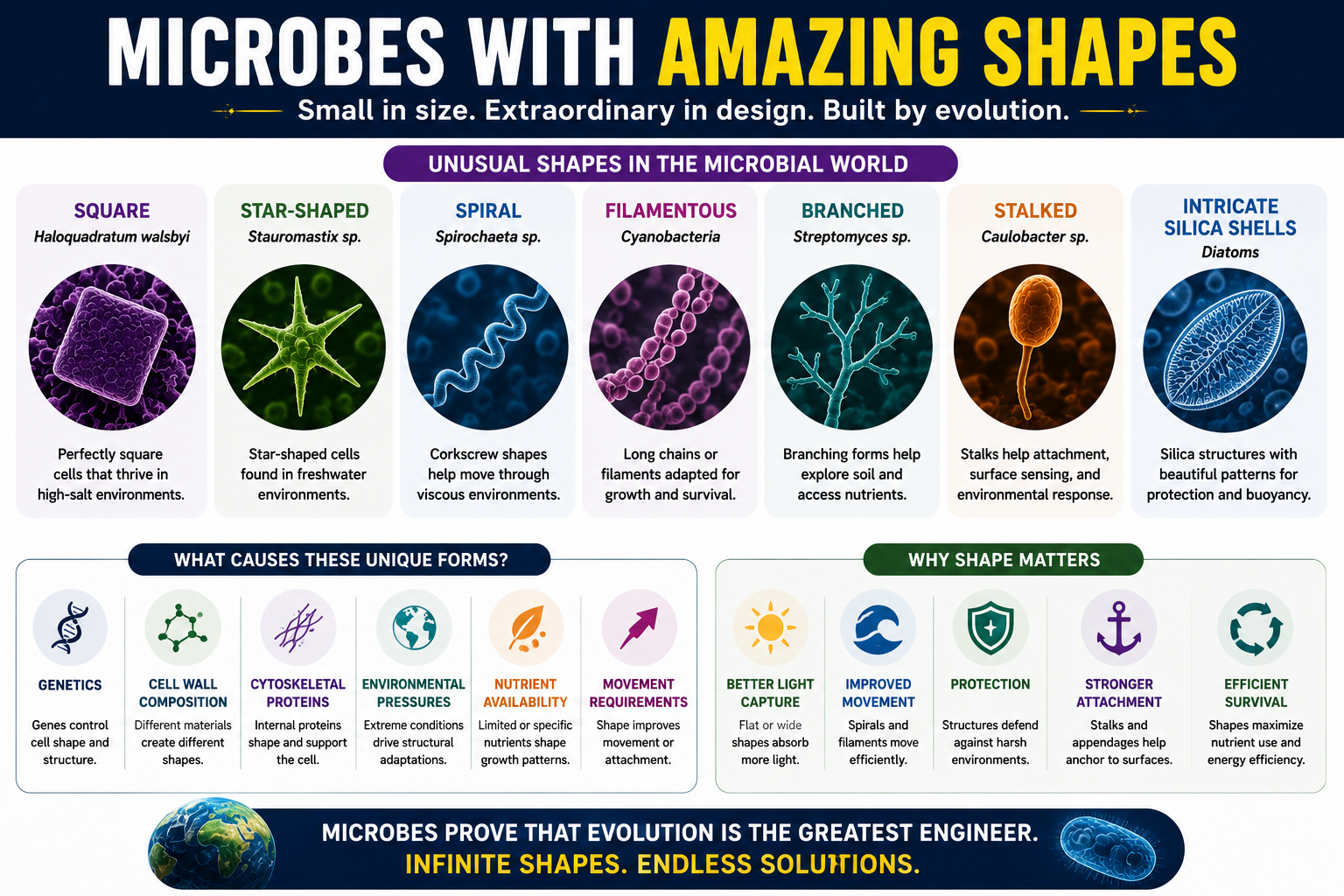
Microbes display an extraordinary range of shapes and structures, many of which are unlike anything seen in larger organisms. While many bacteria are spherical, rod-shaped, or spiral, others possess highly unusual geometries adapted to specific environments and survival strategies.
Some microbes form:
-
star-shaped cells
-
square or rectangular structures
-
filament-like networks
-
branching forms
-
stalked appendages
-
corkscrew spirals
For example, the archaeon Haloquadratum walsbyi has an almost perfectly square shape and thrives in extremely salty environments. Certain cyanobacteria form long chains of connected cells, while spiral-shaped bacteria such as spirochetes use their twisted structure for movement through viscous environments.
Diatoms are among the most structurally remarkable microbes. Their cell walls are made of silica and form intricate microscopic patterns that resemble glass sculptures. These highly organized structures influence buoyancy, light absorption, protection, and nutrient exchange.
Microbial shapes are largely determined by:
-
genetics
-
cell wall composition
-
cytoskeletal proteins
-
environmental pressures
-
nutrient availability
-
movement requirements
Shape often provides direct survival advantages. Elongated or filamentous microbes may absorb nutrients more efficiently, spiral forms can improve mobility, and flattened shapes may increase light capture in aquatic environments.
Some unusual forms also emerge through symbiosis, biofilm formation, or adaptation to extreme habitats such as deep oceans, hypersaline lakes, and hot springs.
Far from being structurally simple, many microbes possess highly specialized architectures shaped by billions of years of evolution and environmental adaptation.
The extraordinary diversity of microbial forms reflects billions of years of evolutionary adaptation to different environments and lifestyles.