
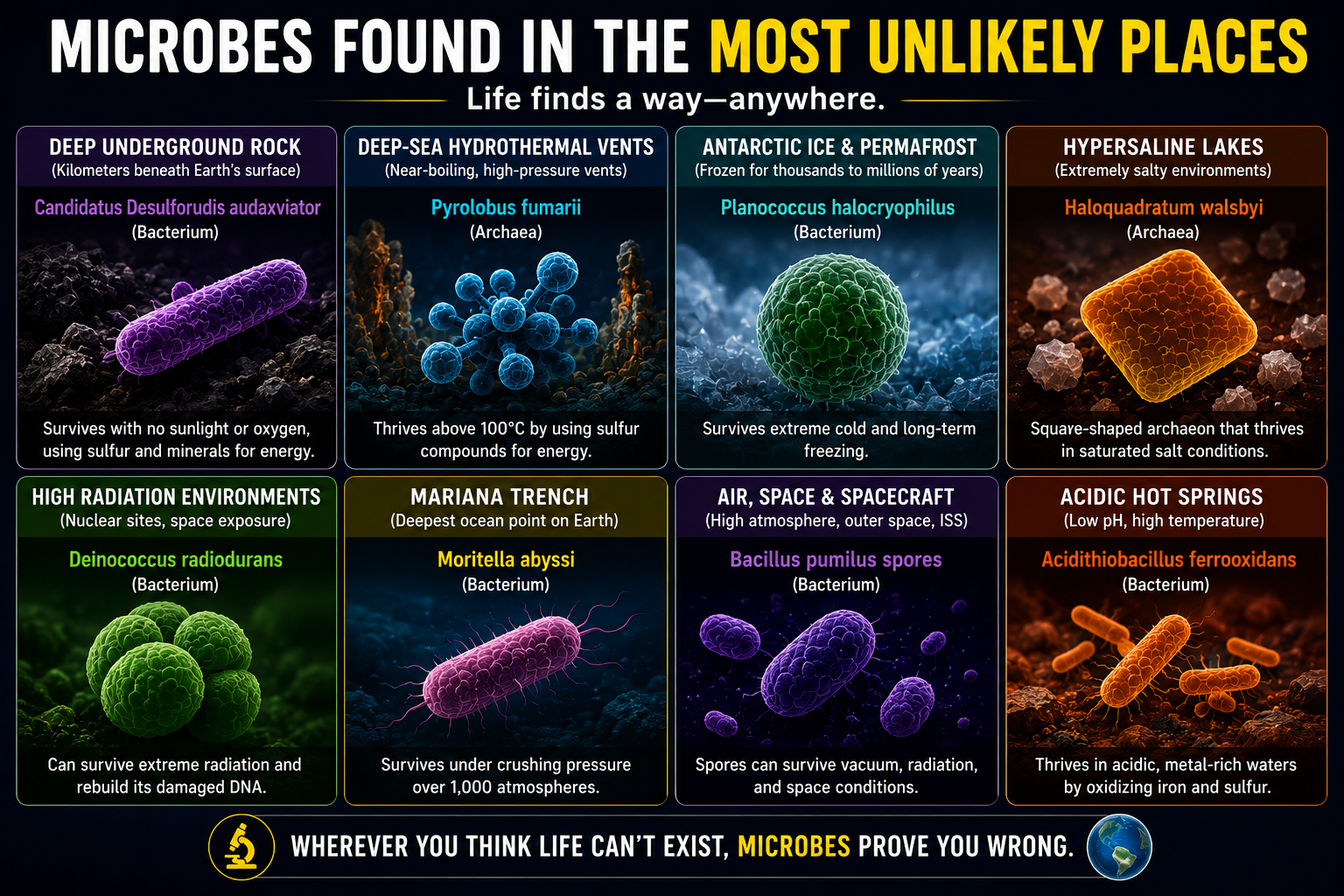
For most of scientific history, researchers assumed life required moderate temperatures, sunlight, oxygen, and stable environmental conditions. Microbes repeatedly proved otherwise.
Deep beneath Earth’s surface, entire microbial ecosystems exist inside cracks within ancient rocks several kilometers underground. These organisms survive with almost no nutrients or sunlight, metabolizing minerals and chemical compounds at extraordinarily slow rates. Some may divide only once in centuries.
At the opposite extreme are the microbes living around deep-sea hydrothermal vents. Here, near-boiling mineral-rich fluids erupt from the ocean floor under immense pressure. Instead of sunlight, these organisms rely on sulfur, methane, hydrogen, and iron for energy through chemosynthesis.
Antarctica has revealed another hidden microbial world. Scientists have recovered living microbes from:
-
ancient ice cores
-
permanently frozen permafrost
-
isolated lakes trapped beneath thick ice sheets
Some remained viable after being frozen for thousands, and possibly millions, of years.
Certain microbes seem almost biologically indestructible. Deinococcus radiodurans can survive radiation doses powerful enough to shatter its DNA repeatedly, then rebuild its genome with remarkable efficiency. Other extremophiles thrive in acidic hot springs, hypersaline lakes, or desert rocks exposed to intense ultraviolet radiation.
Microbes have even been detected high in the atmosphere, on spacecraft surfaces, and aboard the International Space Station. In some astrobiology experiments, microbial spores temporarily survived exposure to the vacuum-like conditions of outer space.
One of the most extraordinary discoveries came from the Mariana Trench, the deepest known region of Earth’s oceans, where microbes persist under pressures exceeding 1,000 atmospheres.
Each of these discoveries has steadily expanded the known boundaries of life. Environments once considered sterile are now understood to host complex microbial ecosystems, raising profound questions about how adaptable life may be both on Earth and elsewhere in the universe.
Extremophilic microbes demonstrate that life can persist under intense pressure, radiation, heat, cold, and nutrient scarcity.