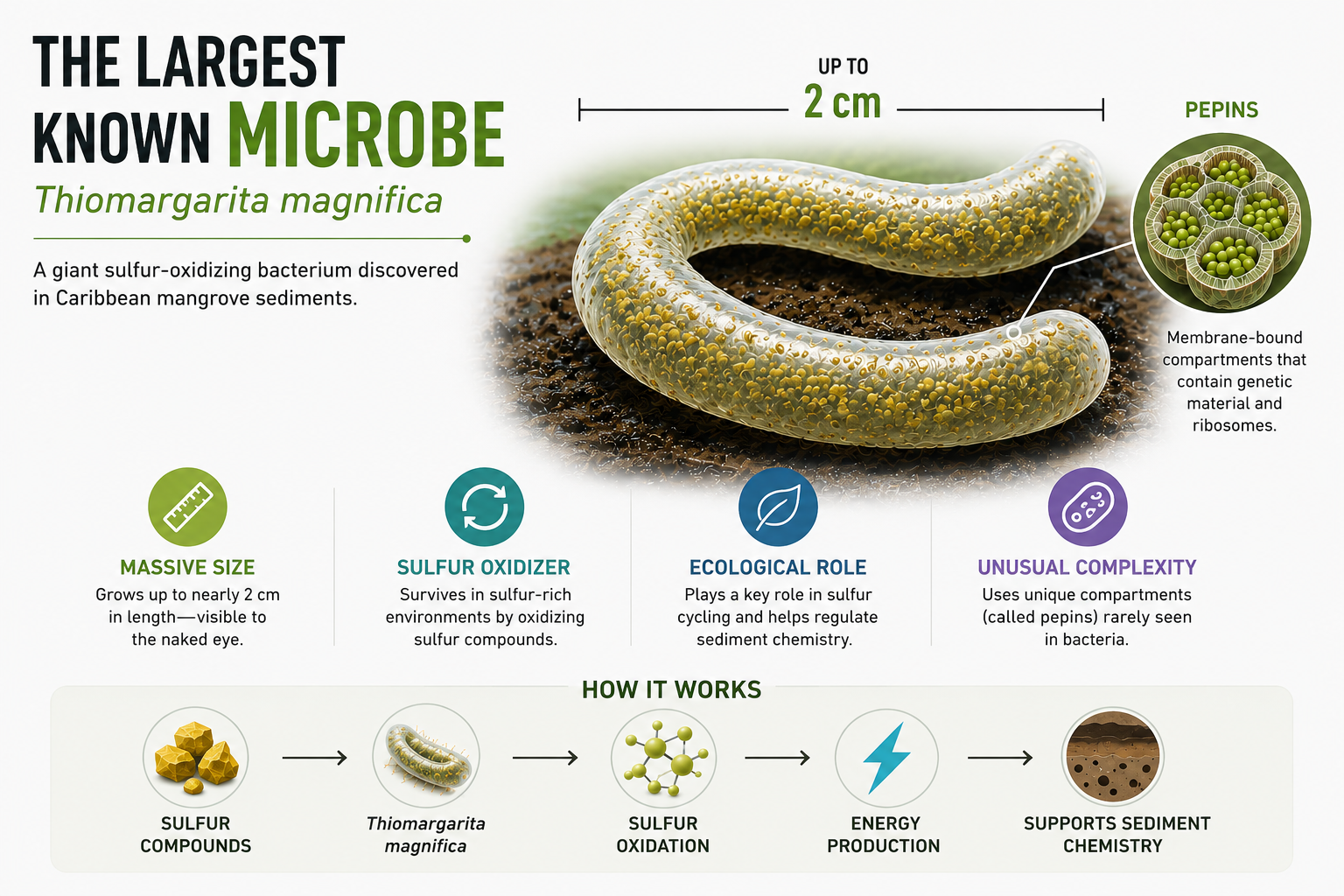
One of the largest known microbes ever discovered is Thiomargarita magnifica, a giant sulfur-oxidizing bacterium identified in Caribbean mangrove sediments and formally described in 2022.
Unlike most bacteria, which are microscopic and invisible to the naked eye, Thiomargarita magnifica can grow up to nearly 2 centimeters in length, making it visible without a microscope and thousands of times larger than typical bacterial cells.
This bacterium survives in sulfur-rich marine environments by oxidizing sulfur compounds to obtain energy. In the process, it participates in sulfur cycling and helps regulate local sediment chemistry.
What made the discovery especially remarkable was not just its size, but its internal complexity. Scientists found that its genetic material and ribosomes are compartmentalized inside membrane-bound structures called pepins, something highly unusual for bacteria. This challenged long-standing assumptions about how simple bacterial cells can become.
Before this discovery, many scientists believed bacterial size was physically constrained by nutrient transport limitations. Thiomargarita magnifica demonstrated that bacterial cells can evolve far beyond those expected limits under certain environmental conditions.
Its discovery has reshaped scientific understanding of bacterial cell architecture, size limitations, and microbial evolution, showing that even some of the most basic assumptions about microbial life are still being rewritten.
Thiomargarita magnifica challenged long-standing assumptions by showing that bacterial cells can become far larger and more complex than previously believed.