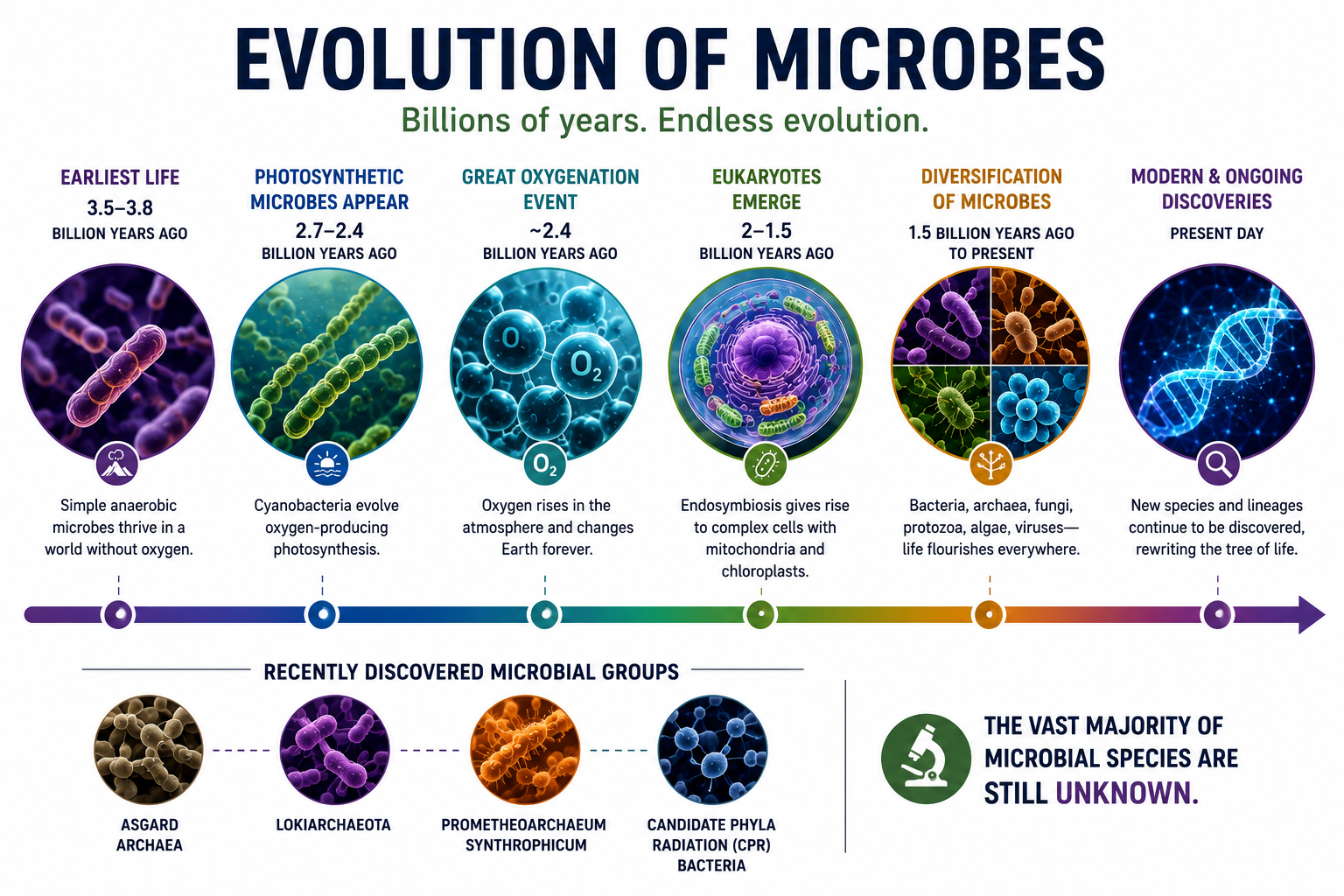
Microbial evolution spans almost the entire history of life on Earth. The earliest microbes likely appeared around 3.5–3.8 billion years ago, when the planet’s atmosphere contained almost no oxygen and Earth’s oceans were chemically rich and volcanically active.
These first organisms were probably simple anaerobic microbes resembling modern archaea and bacteria. Instead of oxygen, they relied on chemical reactions involving hydrogen, sulfur, iron, and methane to obtain energy. Many scientists believe methanogens and sulfur-metabolizing microbes were among the earliest dominant life forms.
Around 2.7–2.4 billion years ago, photosynthetic microbes such as cyanobacteria evolved the ability to release oxygen through photosynthesis. This eventually triggered the Great Oxygenation Event, permanently transforming Earth’s atmosphere and allowing oxygen-based metabolism to spread across many microbial groups.
Recent large-scale evolutionary studies suggest that many major bacterial lineages may have evolved much earlier than previously believed. Evidence also indicates that some oxygen-utilizing metabolic pathways may have appeared before oxygenic photosynthesis became globally dominant.
Between roughly 2 and 1.5 billion years ago, more complex microbial cells called eukaryotes emerged through endosymbiosis, where ancient microbes began living inside larger host cells. These internal microbes eventually evolved into mitochondria and chloroplasts.
Over billions of years, microbes diversified into:
-
bacteria
-
archaea
-
fungi
-
protozoa
-
microscopic algae
-
viruses
They adapted to nearly every environment on Earth, including glaciers, deserts, deep oceans, hydrothermal vents, radioactive environments, and animal digestive systems.
Modern discoveries are still reshaping the microbial evolutionary timeline. Using metagenomics and advanced DNA sequencing, scientists have recently identified entirely new microbial groups such as:
-
Asgard archaea
-
Lokiarchaeota
-
Prometheoarchaeum syntrophicum
-
ultra-small Candidate Phyla Radiation (CPR) bacteria
Many of these organisms were unknown just a few years ago and are changing scientific understanding of evolution, cellular complexity, and the origins of complex life itself.
Microbial evolution represents both the oldest history of life on Earth and one of the most actively evolving areas of modern science.