
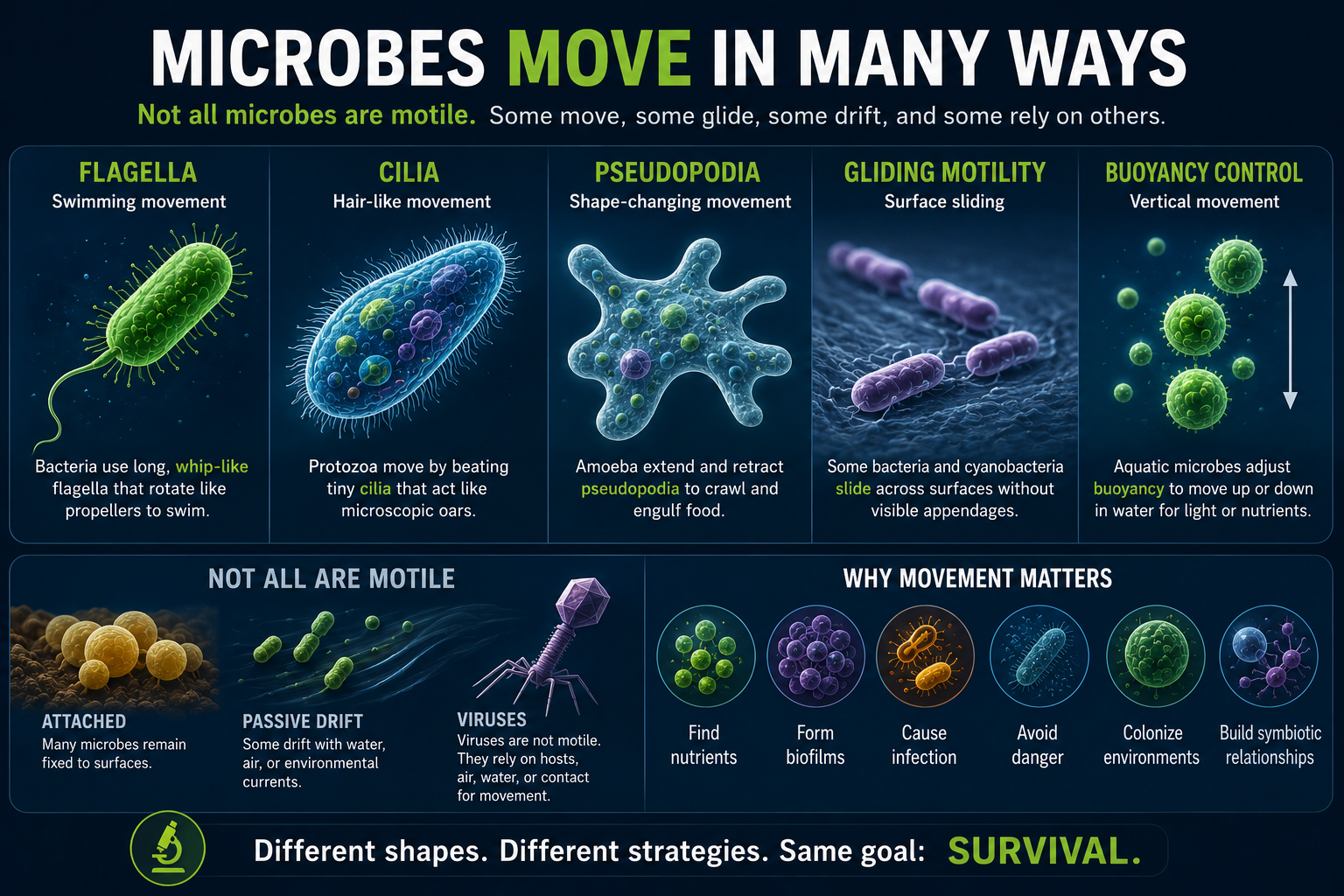
Not all microbes are motile. Many microbial species remain fixed to surfaces, drift passively through water or air, or depend entirely on environmental movement for transport. However, a large number of microbes have evolved highly specialized ways to move through their surroundings.
Many bacteria swim using flagella, long whip-like structures that rotate like microscopic propellers. This allows them to move toward nutrients, light, oxygen, or favorable chemical conditions while avoiding harmful environments, a behavior known as taxis.
Other microbes move very differently. Certain protozoa use tiny hair-like structures called cilia that beat rhythmically to propel the cell through water. Amoeba-like microbes move by extending temporary projections known as pseudopodia, essentially flowing forward by reshaping their own cell bodies.
Some filamentous cyanobacteria and bacteria exhibit a slower movement called gliding motility, where cells slide across surfaces without visible appendages. Certain aquatic microbes also regulate buoyancy rather than actively swimming, allowing them to move vertically through water columns in search of light or nutrients.
Viruses are not motile on their own. They depend entirely on air currents, water flow, host organisms, or physical contact for movement and transmission.
Microbial movement plays major roles in:
-
nutrient acquisition
-
biofilm formation
-
infection processes
-
predator avoidance
-
environmental colonization
-
symbiotic interactions
Despite their microscopic size, many microbes possess remarkably efficient and highly adapted movement systems that allow them to survive in constantly changing environments.
Despite their microscopic size, many microbes possess highly specialized movement systems that allow them to actively navigate and respond to their environments.