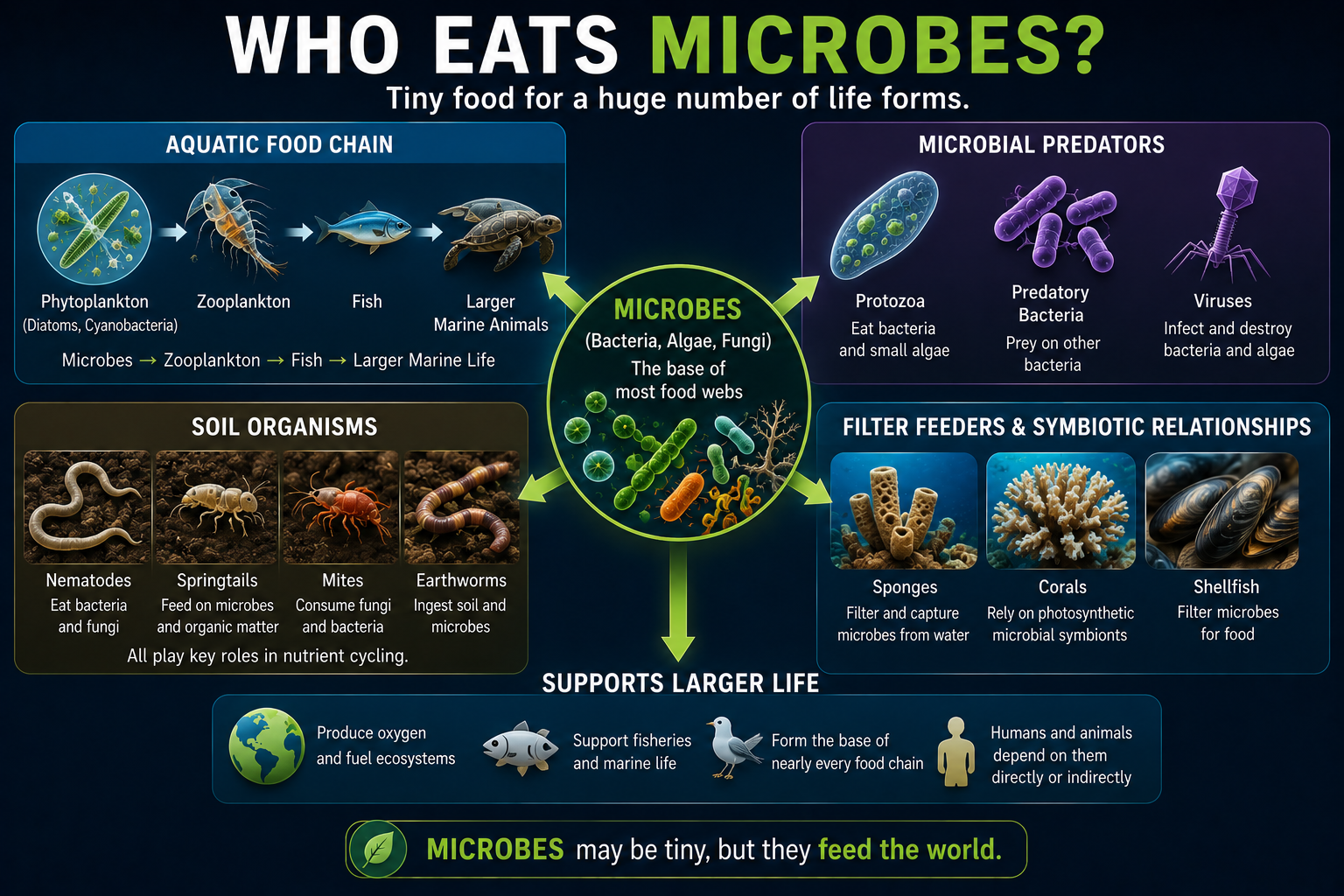
Microbes form the foundation of many food webs, so an enormous range of organisms depend on them directly for energy and nutrition.
In aquatic ecosystems, tiny animals known as zooplankton feed heavily on phytoplankton such as diatoms and cyanobacteria. These zooplankton are then consumed by fish, jellyfish, and larger marine organisms, transferring microbial energy upward through the food chain.
Many microscopic predators also feed on other microbes. Protozoa routinely consume bacteria and smaller algae, while certain bacteria prey on neighboring microbial cells. Even viruses influence microbial populations by infecting and destroying enormous numbers of bacteria and phytoplankton every day.
In soils, organisms such as:
-
nematodes
-
springtails
-
mites
-
earthworms
consume bacteria and fungi as part of nutrient cycling processes.
Some animals maintain direct microbial feeding relationships. Corals rely heavily on photosynthetic microbial symbionts, while filter-feeding organisms such as sponges and shellfish continuously capture microbes from surrounding water.
Humans and other animals also indirectly depend on microbes as the base of larger food chains. Much of the oxygen we breathe and a significant portion of marine productivity ultimately originate from photosynthetic microbes.
Although microbes are microscopic, they support vast networks of life by continuously converting energy and nutrients into forms that larger organisms can consume.
Although microscopic, microbes support vast food webs by providing the energy foundation for countless larger organisms on Earth.