
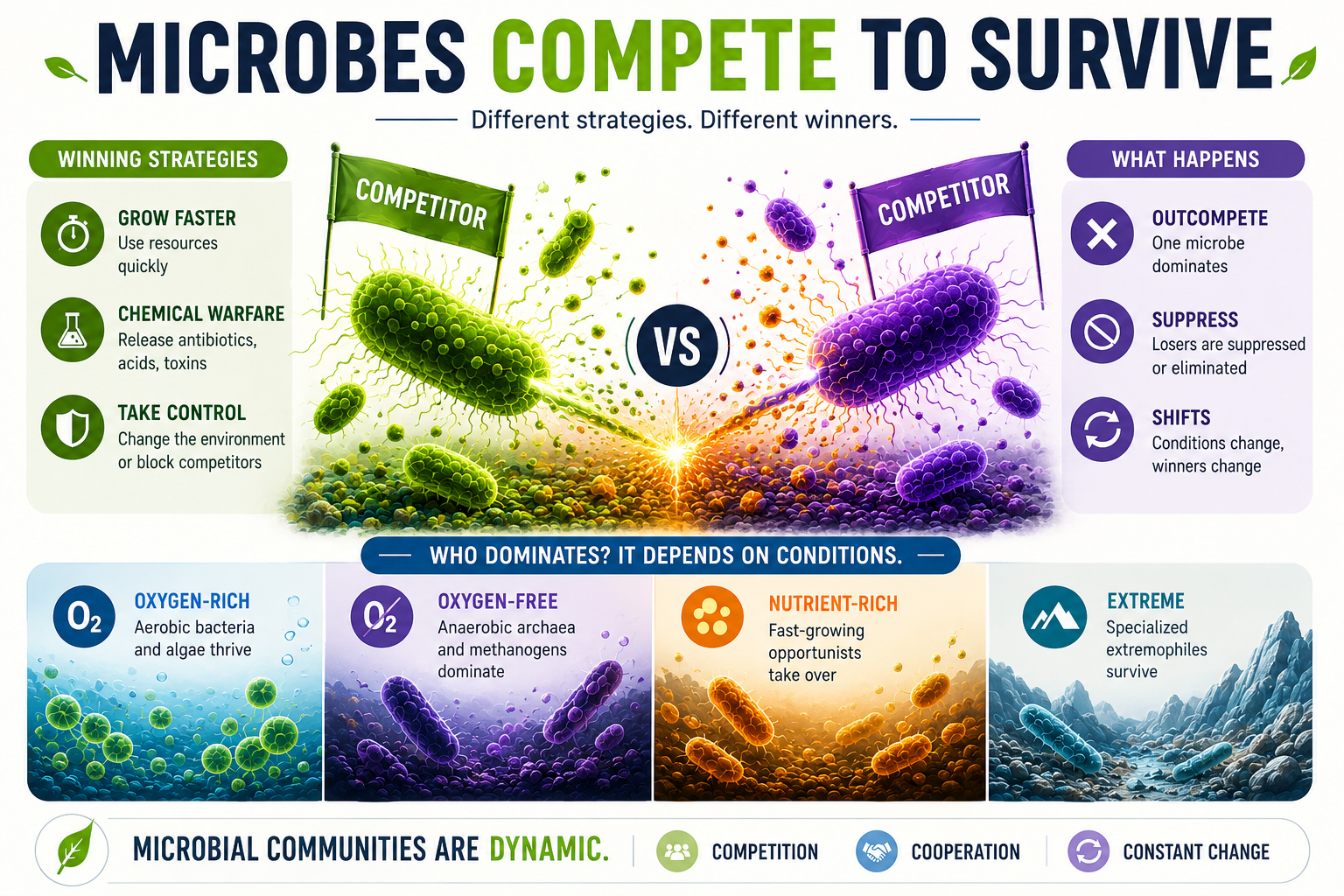
Microbial ecosystems are intensely competitive. In virtually every environment, microbes compete continuously for nutrients, space, oxygen, light, and chemical resources. Because microbial populations can grow extremely rapidly, even small environmental advantages can quickly reshape entire communities.
Some microbes compete by reproducing faster or consuming nutrients more efficiently than neighboring species. Others produce antibiotics, toxins, acids, or inhibitory chemicals that directly suppress competitors. Many fungal species and soil bacteria engage in chemical warfare at microscopic scales, releasing compounds that prevent nearby microbes from growing.
Competition also occurs through environmental modification. Certain microbes alter pH, oxygen levels, or nutrient availability in ways that favor their own survival while making conditions less suitable for rivals. In biofilms, microbial communities may physically block competitors from accessing nutrients or surfaces.
Which microbes dominate depends heavily on environmental conditions. In oxygen-rich waters, photosynthetic microbes and aerobic bacteria may thrive, while oxygen-free sediments favor anaerobic archaea and methane-producing microbes. Nutrient-rich environments often support fast-growing opportunistic species, whereas extreme environments tend to favor highly specialized extremophiles.
Microbial dominance is rarely permanent. Changes in temperature, nutrient supply, salinity, acidity, pollution, or host immunity can rapidly shift microbial balance. A species that dominates one environment may disappear entirely if conditions change slightly.
At the same time, microbial ecosystems are not driven by competition alone. Many microbes also cooperate through nutrient exchange, metabolic partnerships, and signaling systems. In nature, microbial communities are shaped by a constant balance between competition, coexistence, adaptation, and cooperation.
Microbial ecosystems are not static communities, but constantly evolving networks shaped by competition, coexistence, and environmental change.