
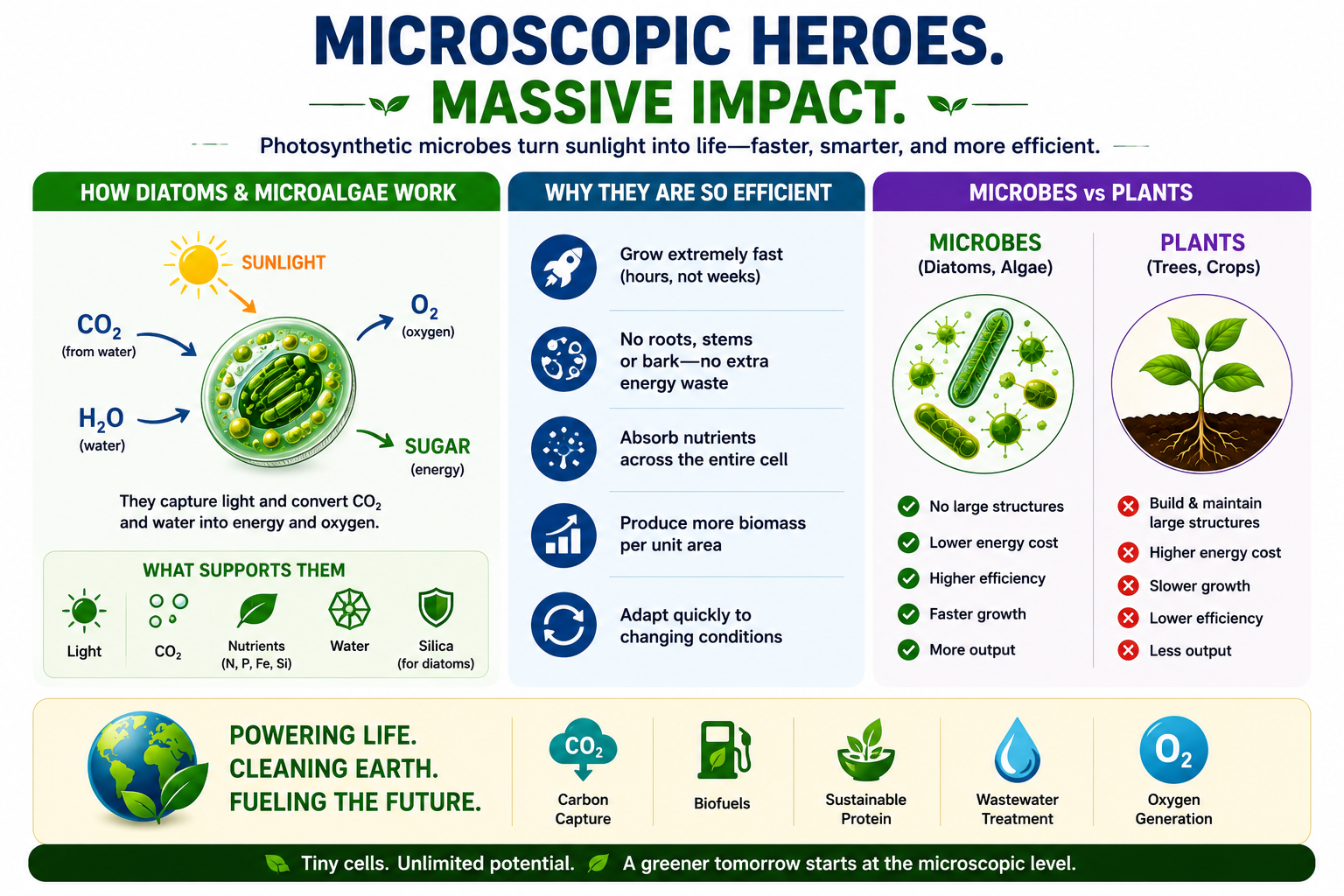
Photosynthetic microbes such as diatoms, cyanobacteria, and microalgae function by capturing sunlight and converting carbon dioxide and water into organic compounds through photosynthesis. In doing so, they generate the chemical energy needed for growth while releasing oxygen as a byproduct.
Diatoms are especially remarkable because their cells are enclosed within intricate silica-based walls called frustules, which function almost like microscopic glass shells. These structures help regulate light capture, protection, buoyancy, and nutrient exchange in aquatic environments.
Their photosynthesis depends on several key components:
-
chlorophyll and accessory pigments that absorb sunlight
-
dissolved carbon dioxide from water
-
nutrients such as nitrogen, phosphorus, iron, and silica
-
specialized internal membranes where light-driven reactions occur
Iron is particularly important in many ocean regions because it supports enzymes involved in photosynthetic electron transport. Silica is essential for diatoms because it is used to construct their frustules.
Unlike terrestrial plants, photosynthetic microbes do not spend energy building roots, stems, bark, or vascular systems. Nearly the entire cell can participate directly in photosynthesis and nutrient absorption. They also absorb dissolved nutrients directly across their surface rather than transporting them through complex tissues.
This gives photosynthetic microbes several advantages over plants:
-
much faster growth rates
-
higher biomass production per unit area
-
rapid adaptation to changing conditions
-
lower structural energy costs
Certain microalgae can double their biomass within hours under ideal conditions, while plants may require weeks or months for comparable growth. In oceans, phytoplankton collectively contribute roughly half of Earth’s oxygen production despite their microscopic size.
However, microbial photosynthesis is also highly sensitive to light intensity, nutrient availability, temperature, water chemistry, and grazing pressure from other organisms.
Because of their efficiency and rapid productivity, photosynthetic microbes are increasingly studied for:
-
carbon capture
-
biofuels
-
sustainable protein production
-
wastewater treatment
-
advanced biotechnology
-
oxygen generation systems for future space missions
Their ability to convert sunlight into biomass at extraordinary speed makes them some of the most efficient photosynthetic systems known in nature.
Unlike plants, photosynthetic microbes devote nearly their entire cell structure to capturing light and producing biomass.