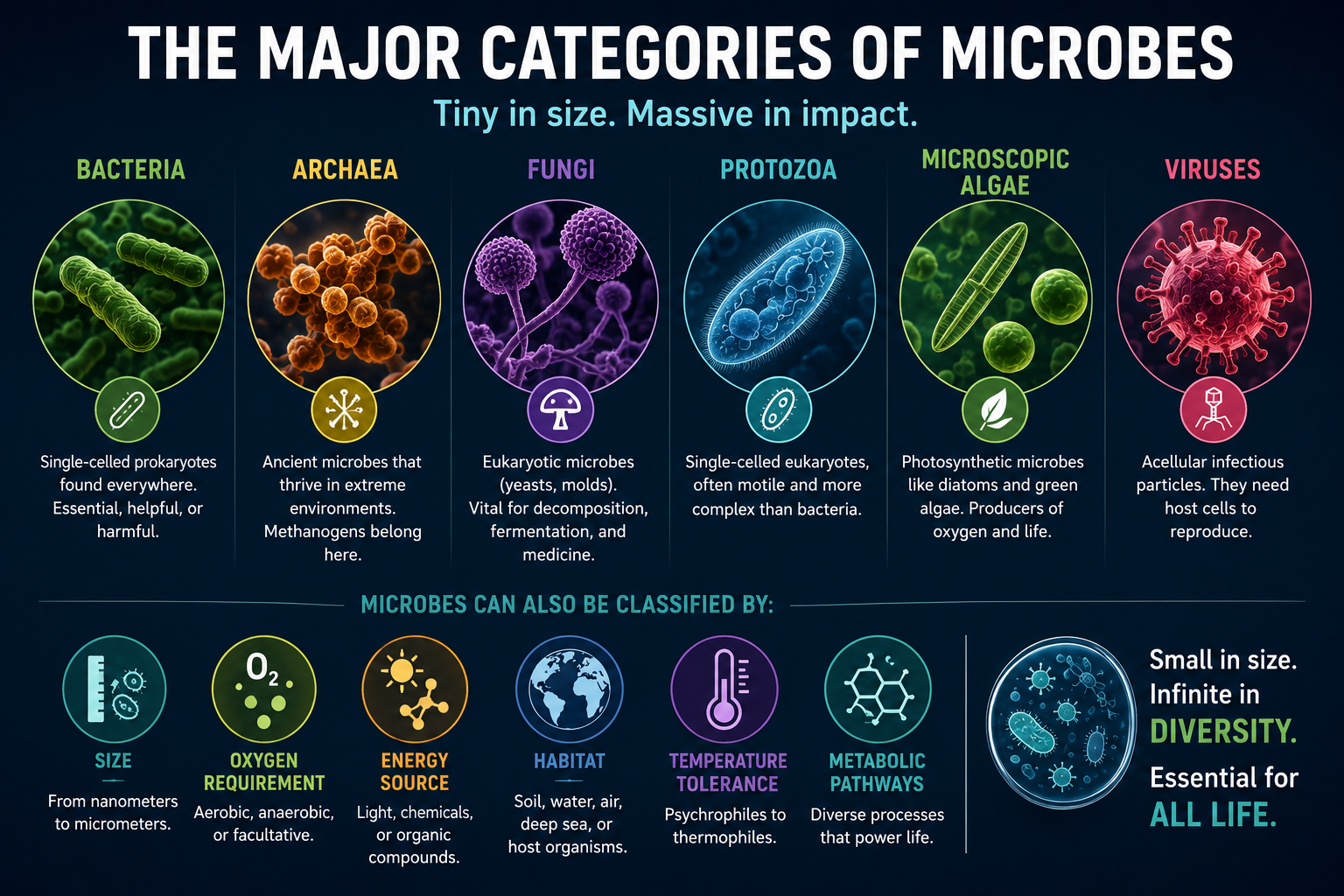
Microbes are grouped based on their cellular structure, complexity, metabolism, and biological functions. Although all microbes are microscopic, they differ enormously in size, genetics, survival strategies, and ecological roles.
The major categories include:
-
Bacteria
Single-celled prokaryotic microbes that lack a nucleus. They are among the most abundant organisms on Earth and can survive in soil, oceans, air, and living organisms. Some are beneficial, while others cause disease. -
Archaea
Ancient single-celled microbes that resemble bacteria but are genetically very different. Many archaea survive in extreme environments such as hot springs, deep-sea vents, and oxygen-free sediments. Methanogens belong to this group. -
Fungi
Includes yeasts and molds. Unlike bacteria and archaea, fungi are eukaryotic and possess a nucleus. They are important in decomposition, fermentation, food production, and antibiotic synthesis. -
Protozoa
Single-celled eukaryotic microbes that are often larger and more complex than bacteria. Many are motile and move using cilia, flagella, or pseudopodia. -
Microscopic Algae
Photosynthetic microbes found mainly in aquatic environments. Groups such as diatoms and green microalgae produce oxygen and form the base of many marine food chains. -
Viruses
Acellular infectious particles that contain genetic material inside a protein coat. Viruses cannot reproduce independently and must infect host cells to replicate.
Microbes can also be classified based on:
-
size
-
oxygen requirement
-
energy source
-
habitat
-
temperature tolerance
-
metabolic pathways
Together, these groups form an extraordinarily diverse microbial world that drives many of Earth’s biological, ecological, and biochemical processes.
Microbes are not a single group of organisms, but a vast collection of biologically distinct life forms that drive many of Earth’s essential processes.