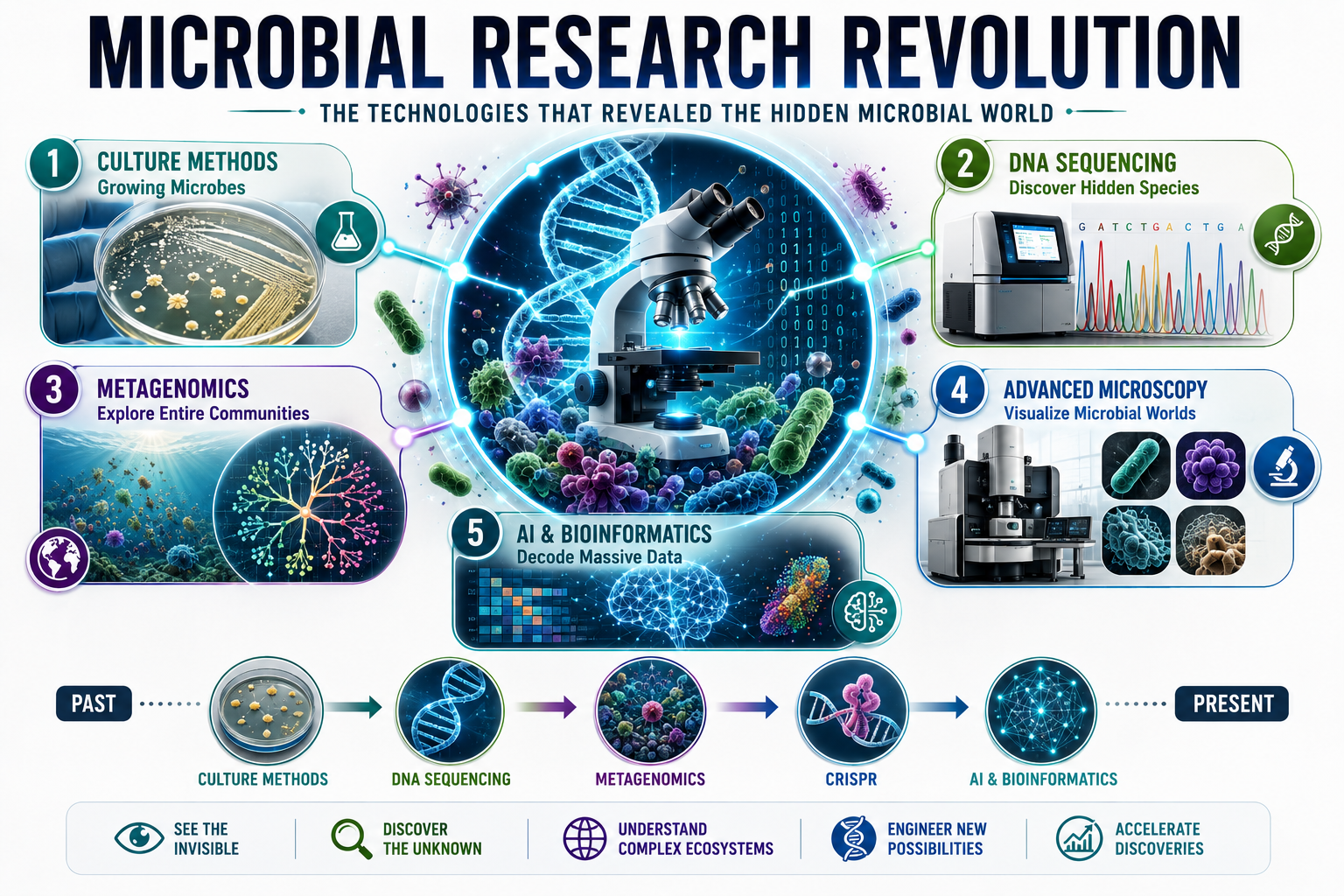
For much of history, microbiologists could study only the microbes they were able to grow in the laboratory. Over the past few decades, new technologies have revealed a microbial world far larger and more complex than scientists ever imagined.
One of the most transformative advances has been DNA sequencing. Modern sequencing technologies allow researchers to identify microbes directly from environmental samples, leading to the discovery of countless previously unknown organisms, including abundant marine microbes such as Prochlorococcus that were once overlooked.
Another major breakthrough is metagenomics, which enables scientists to analyze the collective genetic material of entire microbial communities without culturing individual species. This approach has revolutionized the study of microbiomes in environments ranging from the human gut to the deep ocean.
Advances in microscopy have also transformed microbial research. Electron microscopes and high-resolution imaging techniques allow scientists to observe microbial structures, interactions, and behaviors in remarkable detail.
Genetic engineering tools have further accelerated discovery. Technologies such as CRISPR, originally derived from bacterial defense systems, allow researchers to precisely modify microbial genomes and investigate gene function in organisms such as Escherichia coli and Bacillus subtilis.
More recently, artificial intelligence and bioinformatics have become essential for analyzing the enormous datasets generated by modern microbiology. These tools help researchers identify patterns, predict microbial functions, and uncover relationships that would be difficult to detect manually.
Together, these technologies have transformed microbiology from a field focused on a handful of laboratory organisms into a science capable of exploring entire microbial ecosystems. Many of today's discoveries are possible not because microbes have changed, but because our ability to study them has advanced dramatically
Scientific tools have transformed microbes from unseen mysteries into measurable and predictable biological systems.