Microbes display a level of cellular and metabolic diversity that far exceeds that of plants and animals. While plants and animals rely on a relatively limited set of biological strategies, microbes have evolved countless ways to obtain energy, survive environmental stress, and occupy diverse habitats.
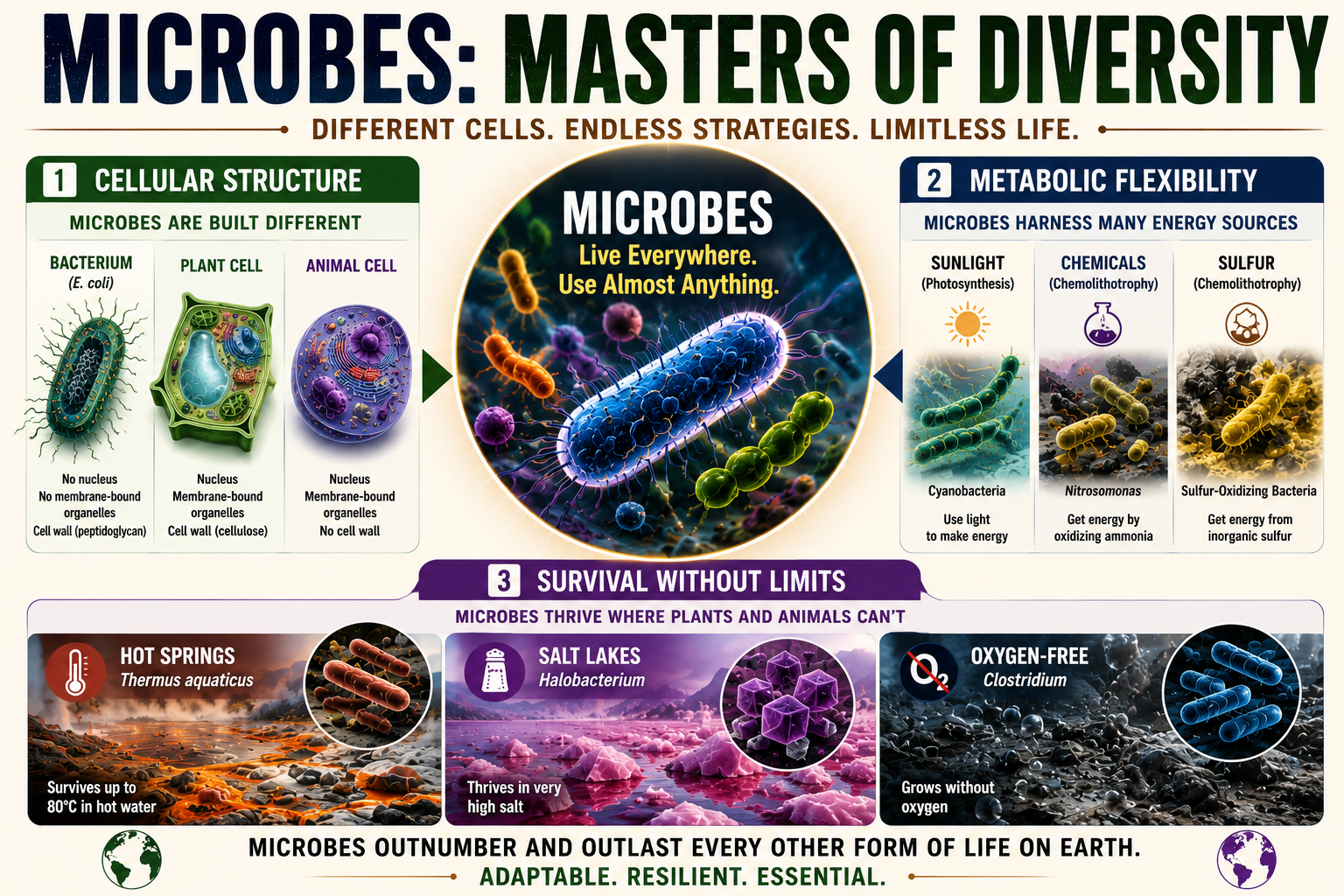
One major difference lies in cellular organization. Bacteria such as Escherichia coli and Bacillus subtilis lack a membrane-bound nucleus, whereas plant and animal cells contain nuclei and other specialized organelles. Many microbes also possess cell walls that differ in composition from those found in plants.
Microbes often contain specialized structures that help them survive and interact with their environment. Flagella allow organisms such as Salmonella to move, while pili help many bacteria attach to surfaces or exchange genetic material. Species such as Bacillus can also form spores that survive heat, dryness, and other harsh conditions.
The greatest differences are often metabolic. Plants obtain energy primarily through photosynthesis, and animals depend on consuming organic matter. Microbes, however, use a remarkable variety of energy sources. Cyanobacteria capture sunlight, Nitrosomonas gains energy by oxidizing ammonia, and sulfur-oxidizing bacteria derive energy from inorganic sulfur compounds.
Many microbes can also thrive where plants and animals cannot. Clostridium species grow without oxygen, Thermus aquaticus survives in hot springs, and Halobacterium flourishes in highly salty environments. These adaptations allow microbes to colonize habitats that are inaccessible to most complex organisms.
This extraordinary flexibility helps explain why microbes are found almost everywhere on Earth. Their diverse cellular structures and metabolic capabilities have enabled them to exploit environments and energy sources far beyond the limits of plants and animals.
A single microbial cell can perform tasks that require entire tissues and organs in larger organisms.