
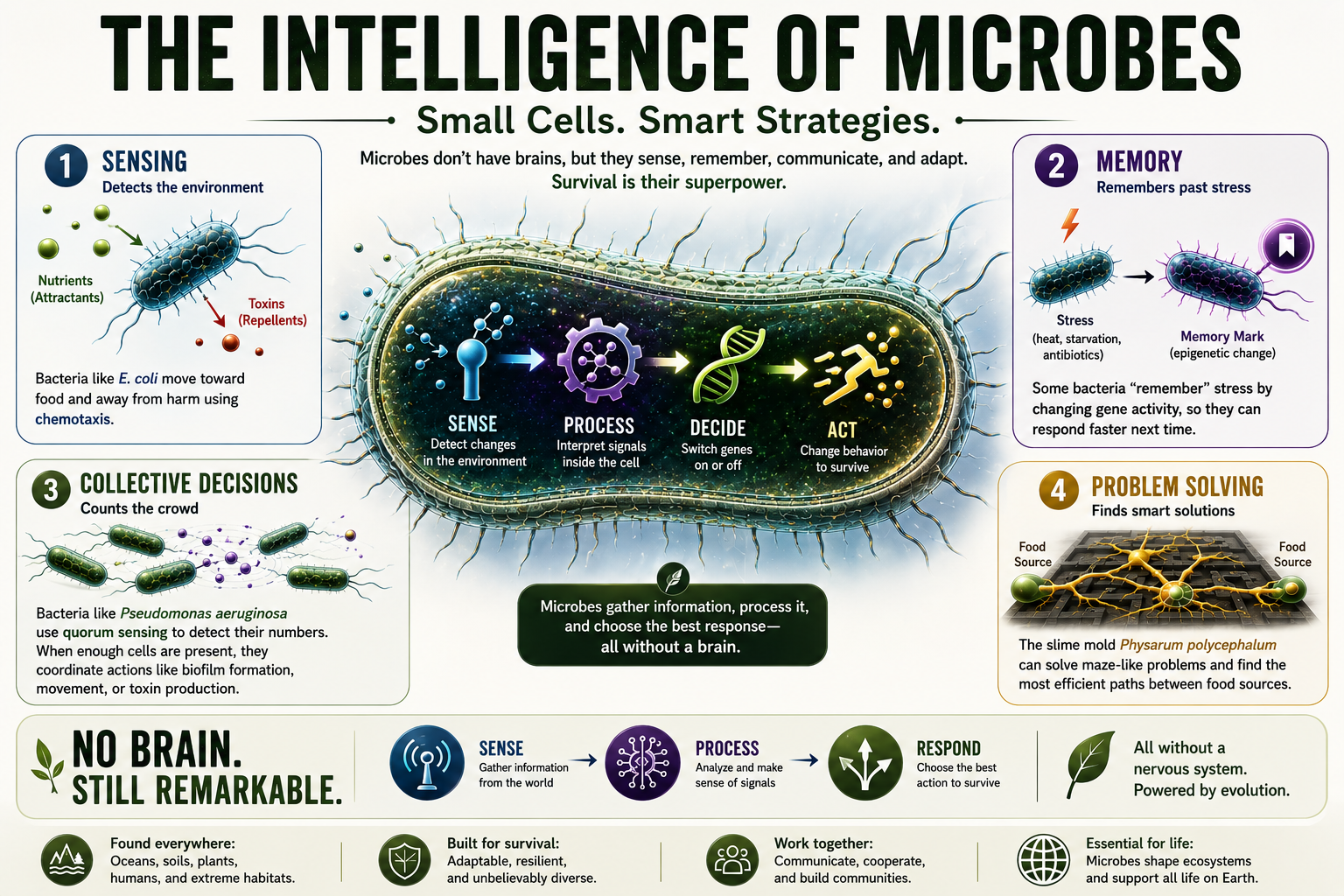
Microbes do not possess brains, nervous systems, or consciousness. However, many microbes can sense their surroundings, store information about past conditions, and alter their behavior in ways that can resemble simple forms of memory and decision-making.
Many bacteria continuously monitor their environment. Organisms such as Escherichia coli can detect changes in nutrients and move toward favorable conditions while avoiding harmful ones, a behavior known as chemotaxis. This allows microbes to respond dynamically rather than react randomly.
Some microbes also exhibit forms of cellular memory. After exposure to stresses such as heat, starvation, or antibiotics, certain bacteria can modify gene activity in ways that help them respond more effectively if the same challenge occurs again.
Microbes often make collective decisions as well. Bacteria such as Pseudomonas aeruginosa use chemical signaling systems known as quorum sensing to monitor the size of their population. When enough cells are present, the community can coordinate behaviors such as biofilm formation, movement, or the production of specific compounds.
Even single-celled organisms can display surprisingly complex responses. The slime mold Physarum polycephalum, although not a bacterium, can solve simple maze-like problems and optimize pathways between food sources, demonstrating that sophisticated behavior does not always require a brain.
These abilities are very different from human learning or conscious decision-making. Nevertheless, microbes are far more responsive and adaptable than once believed. Rather than functioning as simple biological machines, they constantly gather information, process environmental signals, and adjust their behavior in ways that help them survive and thrive.
Long before brains evolved, microbes were already sensing, communicating, and coordinating their actions.