Some microbes are considered extraordinary because they survive in extreme environments, possess unusual biological abilities, or perform functions with major scientific and industrial importance.
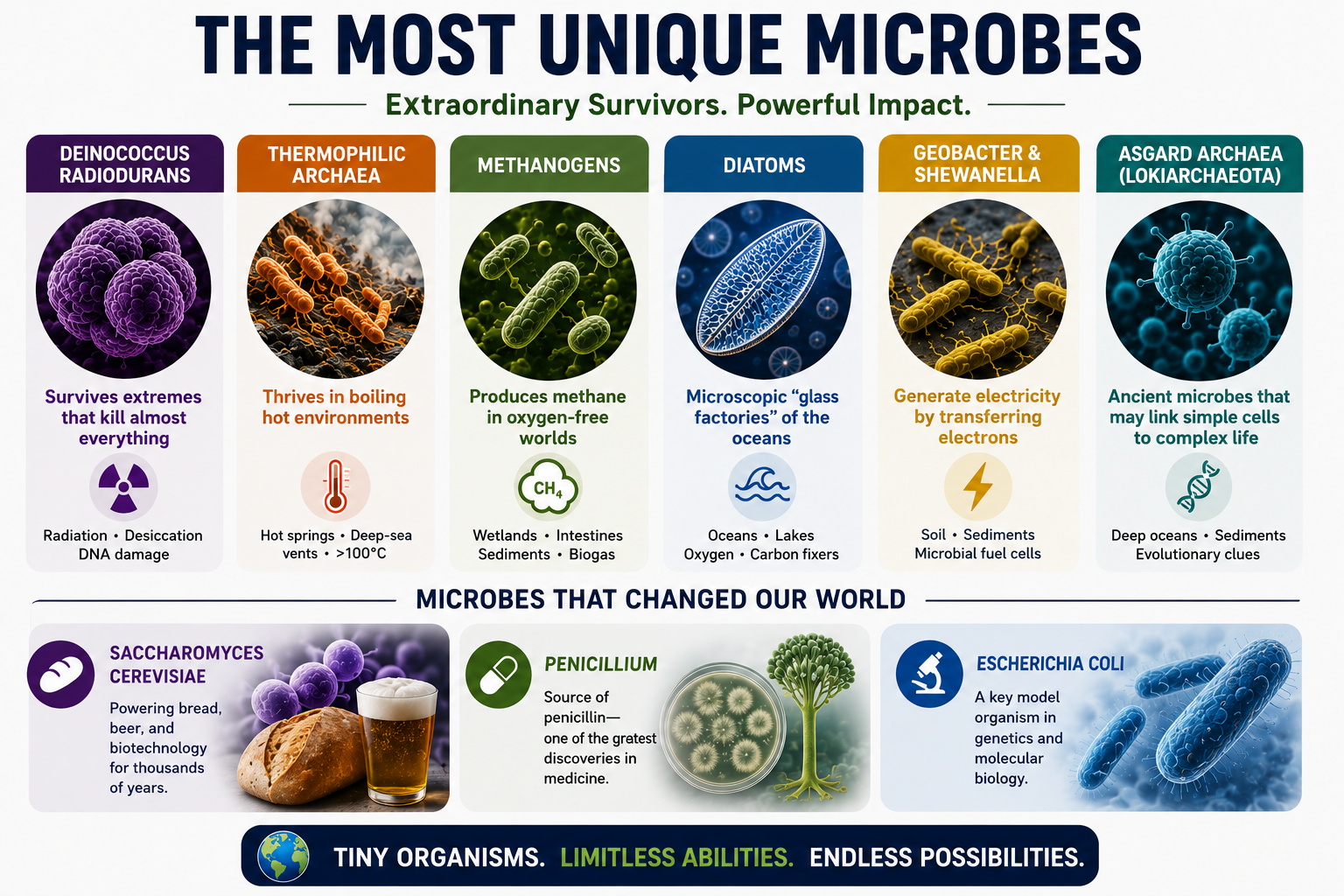
One of the most famous is Deinococcus radiodurans, often called one of the toughest organisms on Earth. It can survive intense radiation, extreme dehydration, and severe DNA damage that would kill most life forms. Scientists study it for applications in radioactive waste remediation and space biology.
Another remarkable group is the thermophilic archaea found near deep-sea hydrothermal vents and hot springs. Some can survive temperatures above 100°C by using sulfur and inorganic chemicals instead of sunlight for energy.
Methanogens are unique archaea that produce methane gas in oxygen-free environments such as wetlands, animal intestines, and deep sediments. They are important in global carbon cycling and biogas production.
Among photosynthetic microbes, diatoms are especially unusual because they build intricate silica-based cell walls that resemble microscopic glass structures. Despite their small size, they contribute significantly to marine oxygen production and carbon fixation.
Certain bacteria such as Geobacter and Shewanella can transfer electrons directly to metals and external surfaces, effectively generating electricity. These microbes are being explored for microbial fuel cells and bioelectrical technologies.
Another highly unusual group includes the recently discovered Asgard archaea, including Lokiarchaeota and Prometheoarchaeum syntrophicum. These microbes may represent evolutionary links between simple microbial cells and complex eukaryotic organisms.
Some microbes are unique not because of extreme survival, but because of their impact on human civilization. For example:
-
Saccharomyces cerevisiae transformed baking, brewing, and biotechnology
-
Penicillium led to the discovery of penicillin
-
Escherichia coli became one of the most important model organisms in genetics and molecular biology
Together, these microbes demonstrate the extraordinary range of microbial evolution, from organisms surviving in extreme planetary conditions to microbes that shaped medicine, energy systems, and modern biotechnology.
Some microbes are considered extraordinary because they combine extreme survival abilities, unusual metabolisms, and major scientific or technological importance.